
Agrifuture’s expertise, developed as Futurology’s agricultural division through more than 12 years of work in precision agriculture, agricultural drones, and autonomous systems, is now becoming part of the global dialogue on the development of technologies, regulatory models, and new approaches to agricultural business. It is also playing an increasingly active role in shaping the international vision of the future of agricultural production.
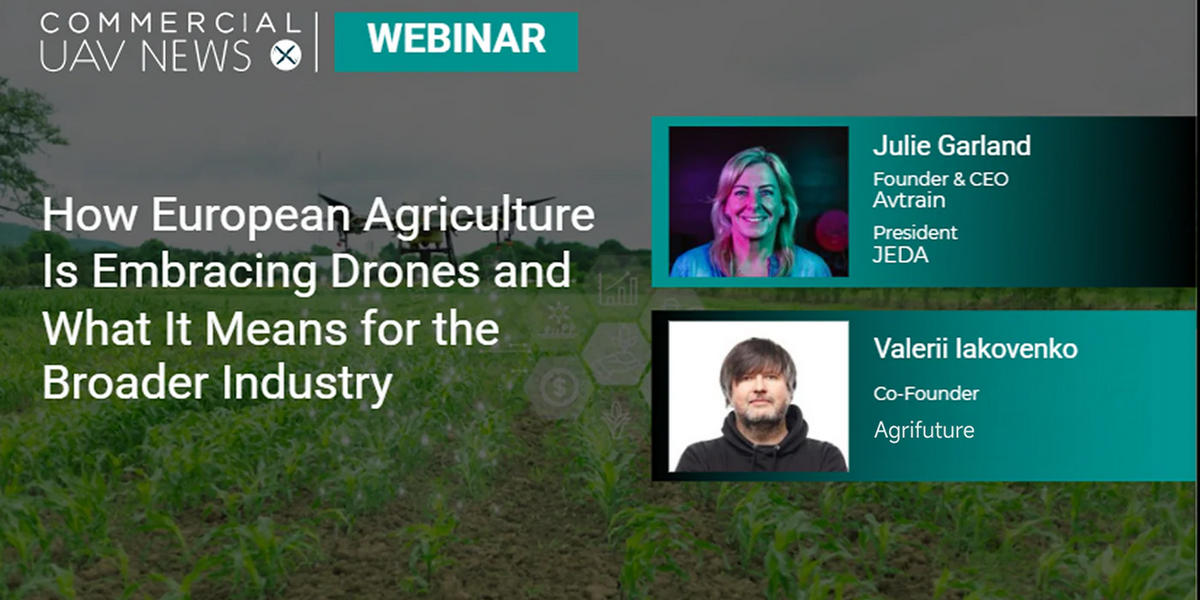
These issues were central to the international webinar“How European Farmers Use Agricultural Drones: Current Experience and Best Practices,” organized by Commercial UAV News. During the discussion, industry representatives explored how agricultural drones are already transforming European agricultural production, which regulatory barriers are limiting the scaling of these technologies, how business models are evolving, and why robotization is becoming one of the defining factors in the competitiveness of the agricultural sector.
Agrifuture’s experience was presented by Valerii Iakovenko, founder of Agrifuture, co-founder of Futurology, former drone expert at the Food and Agriculture Organization of the United Nations, and Co-Chair of the Agricultural Committee of the Pennsylvania Drone Association. Together with Julie Garland, founder and CEO of Avtrain and President of the Joint European Drone Associations, he outlined the key changes currently shaping the development of the agricultural drone market in Europe, the United States, and other regions.


One of the central topics was the changing role of unmanned technologies in agriculture. At the initial stage, drones were used primarily for field monitoring, identifying problem areas, and creating maps. Today, however, they are increasingly becoming a fully integrated part of the production process.
“We have moved from identifying problems to directly carrying out technological operations. Today, agricultural drones are no longer merely observation tools but a fully integrated part of agricultural production,” said Valerii Iakovenko.
This shift from observation to the execution of operations marks a new stage in the development of the industry. Agricultural drones are being integrated into farm production processes, complementing other autonomous systems and laying the foundation for the broader robotization of agricultural production.
Particular attention during the discussion was given to the European experience, where the first markets emerged in which agricultural drones progressed from pilot projects to large-scale practical use. Close cooperation between technology companies, agricultural producers, and relevant institutions has made it possible to establish one of the most advanced ecosystems of unmanned agricultural technologies.
Agrifuture’s experience, developed in Europe, makes it possible to assess agricultural drones not as a standalone innovation but as part of the real production economy, influencing efficiency, operational flexibility, and the ability of agricultural companies to adapt quickly to new conditions.
Valerii Iakovenko’s position focused not only on technological capabilities but also on the broader business logic behind the development of the industry. Agricultural robotization has already become a factor in the competitiveness not only of individual companies but also of entire economies.
“Today, countries compete not only in terms of food production volumes. They compete through technology. Those that integrate agricultural drones and autonomous systems more quickly gain a strategic advantage in the global market,” Valerii Iakovenko emphasized.


The regulatory environment was another important part of the discussion. Today, the technological readiness of the market often exceeds the readiness of the regulatory framework. In Europe, the main challenges remain differences between national regulations, the absence of unified approaches to the use of agricultural drones, and the difficulty of scaling operations across countries.
One important aspect of the industry’s development is that regulation must extend beyond aviation rules alone. The market requires a comprehensive approach that takes into account professional operator training, the safe handling of materials, the responsibility of service companies, and personnel protection.
“Safety is not a formality. Professional training, proper procedures, and responsible regulation must be fundamental conditions for market development,” he stressed.
Equally important is the effective integration of different technological approaches, including drones, satellite-based methods, and other digital tools. The webinar presented a concept emphasizing that the future of the industry lies not in competition between individual solutions, but in their synergy, where satellite monitoring, unmanned systems, digital tools, and robotics form a unified technological ecosystem for the modern agricultural enterprise.
“The future is not only about drones. The future is agricultural robotization. Autonomous technologies, digital twins, satellite systems, and robotic platforms will shape a new model of agriculture,” Valerii Iakovenko concluded.
Agrifuture’s participation in the international discussion confirms that the company’s expertise in agricultural robotics, developed in the European market, is among the key contributors to the global process of shaping new technological, regulatory, and business models. Today, this experience is being used to develop the market in the United States, discussed at the European level, and becoming a foundation for scaling international agricultural production.


The Agrifuture team thanks Commercial UAV News for organizing the professional discussion and Julie Garland for the meaningful exchange of expertise on the future of agricultural drones and the transformation of the industry.


Leave a comment
This site is protected by hCaptcha and the hCaptcha Privacy Policy and Terms of Service apply.